It's been a while since I posted here. Last year, I put out the top-bar hive (Hive Beta) and installed bees into it. I also cleaned and put new bees into my two Langstroth hives (Hive A and Hive B). They all seemed to do well, but I ended up combining medium hive bodies from Hive B to Hive A so that Hive A would survive the winter. Hive Beta seemed to be behind, and I think it was due to me not much feeding syrup to them and the bees truly starting from scratch--an empty hive with no foundation or wax at all.
We put a thermometer into Hive A, and we could see that the bees were alive as recently as late-January of 2016. In fact, on one day, the hive was in the high-90's when the ambient temperature in the area was well below freezing.
I have yet to check Hive A or Hive Beta. I don't think that either survived, but I haven't had a chance to crack either of them open. I did put straw bales around them this year, and that is a first for me.
Going forward, I'm going to move to deep hive bodies. I only need to use three of them instead of the five mediums that I have been using. They will be heavier, but easier to and track.
I just got word that the bees are coming Sunday, April 10, 2016. I tried a guy who is closer than the place I was using in Stillwater, so we'll see how pick-up goes.
I need to get the hive bodies ready. They are assembled, but I have to drill the holes, get the corks, prime them, and paint them. I also have to assemble at least 20 frames for the deeps.
Showing posts with label top bar hive. Show all posts
Showing posts with label top bar hive. Show all posts
Tuesday, April 5, 2016

Wednesday, June 5, 2013
Kenyan top-bar hive.
A few summers ago, my dad and I made a Kenyan top-bar hive.
It is meant to emulate a hollowed-out log hive with bars across the top, presumably used in Kenya and the surrounding areas.
I entered into the Nicollet County Fair last summer and received a blue ribbon and a $2 - $3 prize. I was so drenched in fame and fortune that I could no longer appear in public. However, that's a story for another post...
The following two pictures show the hive with the top cover (the blue-colored cover) off. You can see four of the bars standing upright. This shows you the underside of the bars. A thin wood strip is embedded into the bottom of the bars. The goal is that these will prompt the bees to build comb on each bar's underside there and there only.
You can also see into the hive itself. The large, empty cavity will be eventually filled with parallel strips of comb growing down from the bars arranged across the top.


Below was my attempt to put the camera into the hive and take a picture of the underside of the bars. This is what the bees would "see" from within the hive. They would ideally see the rows of low points and build comb down from each wooden strip.
In case the pictures are difficult to interpret, the main part of the hive is like a large, trapezoidal, feeding or watering trough. This shape keeps the bees from attaching comb to the sides of the hive. The bars are placed across the top. They fit together with no gap between the bars. On the underside of the bars, a thin strip of wood was glued in. Think of a popsicle stick, but larger and a bit thicker. The idea with this "starter strip" is that the bees will use these to guide their comb production. Hence, the comb will be nicely parallel and allow me to inspect the hive without destroying "cross comb" pieces.
I haven't yet put bees into it, as I heard that bees cannot over-winter in MN in a top-bar hive. However, another blog that I follow (http://topbarbeesmn.blogspot.com) and blogs mentioned by the author give me hope that I might be able to get bees to survive the winter in the Kenyan top-bar hive.
My plan now is to place it out in the prairie next spring. If my two current hives survive the winter, they may be likely to swarm next spring/summer. If I can either catch a swarm to install it into the Kenyan top-bar hive or bait a swarm into it, I can get going with that hive.
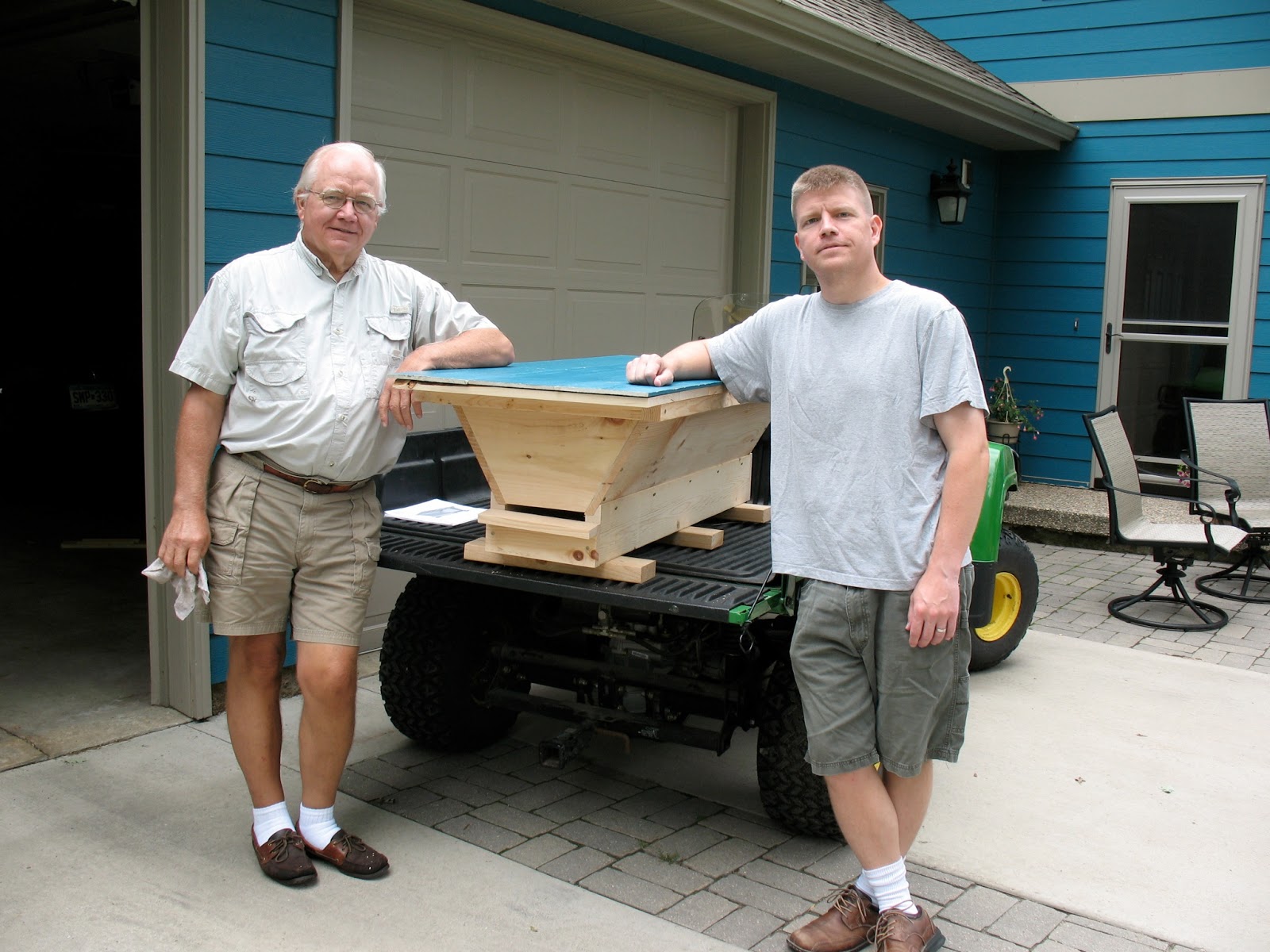 |
| Kenyan top-bar hive carpenters and their finished product. |
It is meant to emulate a hollowed-out log hive with bars across the top, presumably used in Kenya and the surrounding areas.
 |
| Front-ish view. |
 |
| Side view. |
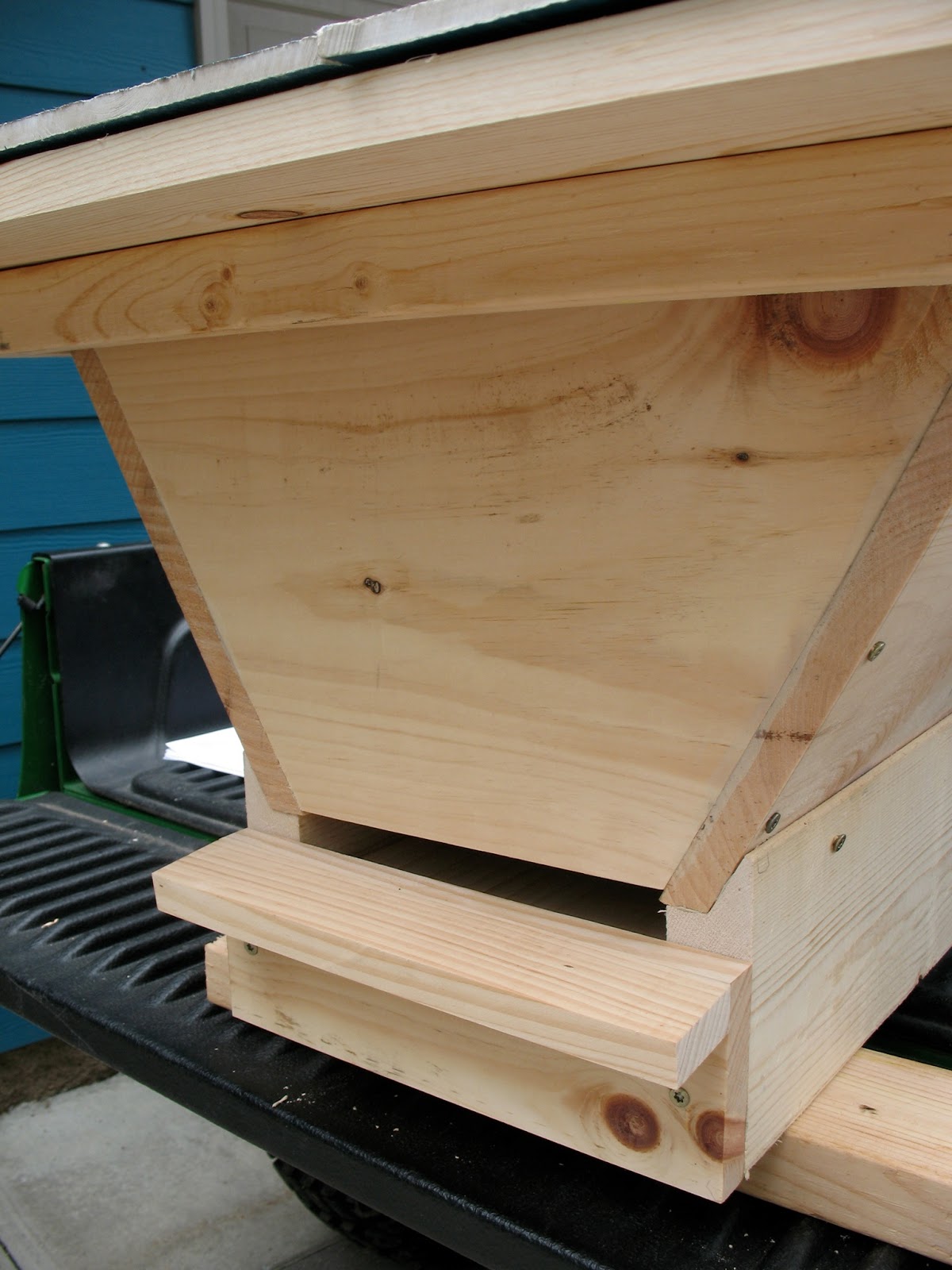 |
| A closer view of the entrance and the landing board. |
I entered into the Nicollet County Fair last summer and received a blue ribbon and a $2 - $3 prize. I was so drenched in fame and fortune that I could no longer appear in public. However, that's a story for another post...
 |
| A view of the underside of the top cover. |
 |
| The cover is off, and you can see the top surface of the cover. That the cover surface is suspiciously like the house's siding is purely coincidental, of course. |
The following two pictures show the hive with the top cover (the blue-colored cover) off. You can see four of the bars standing upright. This shows you the underside of the bars. A thin wood strip is embedded into the bottom of the bars. The goal is that these will prompt the bees to build comb on each bar's underside there and there only.
You can also see into the hive itself. The large, empty cavity will be eventually filled with parallel strips of comb growing down from the bars arranged across the top.


Below was my attempt to put the camera into the hive and take a picture of the underside of the bars. This is what the bees would "see" from within the hive. They would ideally see the rows of low points and build comb down from each wooden strip.
 |
| A view from inside the hive, looking up at the top bars. |
In case the pictures are difficult to interpret, the main part of the hive is like a large, trapezoidal, feeding or watering trough. This shape keeps the bees from attaching comb to the sides of the hive. The bars are placed across the top. They fit together with no gap between the bars. On the underside of the bars, a thin strip of wood was glued in. Think of a popsicle stick, but larger and a bit thicker. The idea with this "starter strip" is that the bees will use these to guide their comb production. Hence, the comb will be nicely parallel and allow me to inspect the hive without destroying "cross comb" pieces.
I haven't yet put bees into it, as I heard that bees cannot over-winter in MN in a top-bar hive. However, another blog that I follow (http://topbarbeesmn.blogspot.com) and blogs mentioned by the author give me hope that I might be able to get bees to survive the winter in the Kenyan top-bar hive.
My plan now is to place it out in the prairie next spring. If my two current hives survive the winter, they may be likely to swarm next spring/summer. If I can either catch a swarm to install it into the Kenyan top-bar hive or bait a swarm into it, I can get going with that hive.
Subscribe to:
Posts (Atom)