Vaughn and I checked the hives today about about 1315. Each hive had eaten through the mini-marshmallow to free the queen. The queen cages were each full of workers, as it probably still smelled strongly of the queen. To avoid confusion in the hive, I got all of the bees out of the queen cage and put it in my pocket. Now, the only queen smell coming from the inside of the hive should be from the actual queen.
We didn't use our smokers, so we tried to not spend much time in the hives. I did not search for or see either queen. They still had plenty of syrup left in their feeder pails, but I'll probably mix up another gallon of syrup today to have in reserve.
The hive entrances were busy on both hives.
The plan is to leave them alone for a week or two. Then, I'll use the smoker to give each hive an inspection. I'll hope to see the queen. If not, I'll be happy to see some eggs, larvae, and/or capped brood.
I may also get ready to add a second, deep hive body to each.
Sunday, April 21, 2019

Saturday, April 20, 2019
2019-04-20: Hiving two packages of bees.
I had a couple of years with no bees. First, I did not find out that they had died over the winter a couple of years ago until it was too late to order new bees. Then, it sort of slipped my mind last spring.

I have the two packages of bees, and I'm wearing my bee suit. If you watch other people's videos, they often don't wear a bee suit. The reason is that the bees do not have a hive to protect, so they tend to be more docile.

So, this year, I ordered two packages from my usual supplier, Nature's Nectar. I had one package each of Carniolan Honeybees and Italian Honeybees. I did not really care which bees I got, but I usually do not get two of the same subspecies.
This was the first year that my packages were plastic. I like the old wood and metal screen ones better, since I can see the bees easier. I also would learn that it was easier to spray the bees with sugar water through the metal screen compared to the plastic packaging.
It was about a two-hour drive home, but the weather was mild; the bees probably did not get too hot.
I picked up the bees at 0915, but they suggest that you do not hive them until the evening. So, they sat in the cool garage for most of the day. I sprayed them with sugar water once to feed, calm, and cool them.
Finally, 1800 arrived, and we were ready to hive the bees.

I have the two packages of bees, and I'm wearing my bee suit. If you watch other people's videos, they often don't wear a bee suit. The reason is that the bees do not have a hive to protect, so they tend to be more docile.

Here I am with my helper, Vaughn. I'm having some difficulty uploading the videos, so I'll outline the steps that we did:
- The syrup-soaked bees will be "poured" into the center of the bottom (and--at this time--only) hive body, so we removed the center four or so frames.
- Plug the entrance with the entrance reducer on the smallest setting and block that temporarily with a wad of prairie grass.
- Soak the bees well with syrup from the spray bottle.
- Use the hive tools to pry the metal can from the package. (This is the syrup the bees ate during their trip from CA to MN and then from Stillwater to me.)
- Once the can is out, spray the bees some more.
- Remove the queen's cage (she is transported separately) and set it aside.
- Knock the bees to the bottom of their package by striking the package against the ground.
- Pour the syrup-soaked bees into the hive.
- Leave the mostly-empty package near the entrance so the bees can eventually get into there (the bees will probably push the grass out of the hole over the evening).
- Take the wood cork out of the queen's cage, and replace it with a mini-marshmallow.
- Put a pollen patty on the top of the frames for the bees to eat until they can bring in a good supply of pollen from plants.
- Put on the inner cover (the board with an oblong hole in it).
- Put the feeder pail over that hole so that the bees can feed from that until they are able to bring in nectar from flowers.
- Put an empty hive body over the pail.
- Put the outer cover over the empty hive body.
The next step, which we will probably do tomorrow, is to check the queen's cage. Ideally, the marshmallow will have been eaten by the bees so that the queen can exit the cage and start laying eggs.
Monday, April 11, 2016
Beekeeping Reboot.
For the last three beekeeping seasons, I have been using five medium hive bodies for my hive's brood chambers. It doesn't sound like much, but having to deal with a five-box hive is more time-consuming than I thought it would be. So, this year, I bought new hive materials that would allow me to move to a hive that is comprised of three deep hive bodies.
My bees arrived yesterday, so I was busy last week getting the hives assembled and painted.
I purchased unassembled hive bodies and nails from Mann Lake, Ltd. Below is a picture of some of them assembled.

Here is one primed and with the hole in place.

Here is a shot of one of my "employees" painting a hive body light blue.

I also ordered new outer covers, inner covers, and screened bottom boards. I decided to try black foundation for the frames this time. It is supposed to make it easier to see the eggs and small larvae. Below is a picture of an empty, assembled frame. Below that is a picture of the foundation that will go into those frames. Below that further are the assembled and painted pieces on our lawn, airing out.
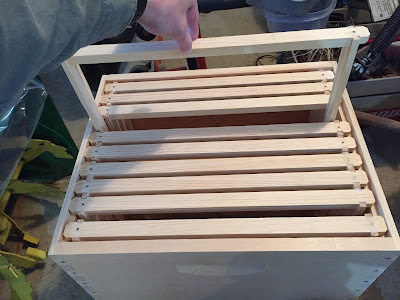


Lastly, pictures of the assembled, painted, labelled hives. They are on their stand and ready for bees.


My bees arrived yesterday, so I was busy last week getting the hives assembled and painted.
I purchased unassembled hive bodies and nails from Mann Lake, Ltd. Below is a picture of some of them assembled.
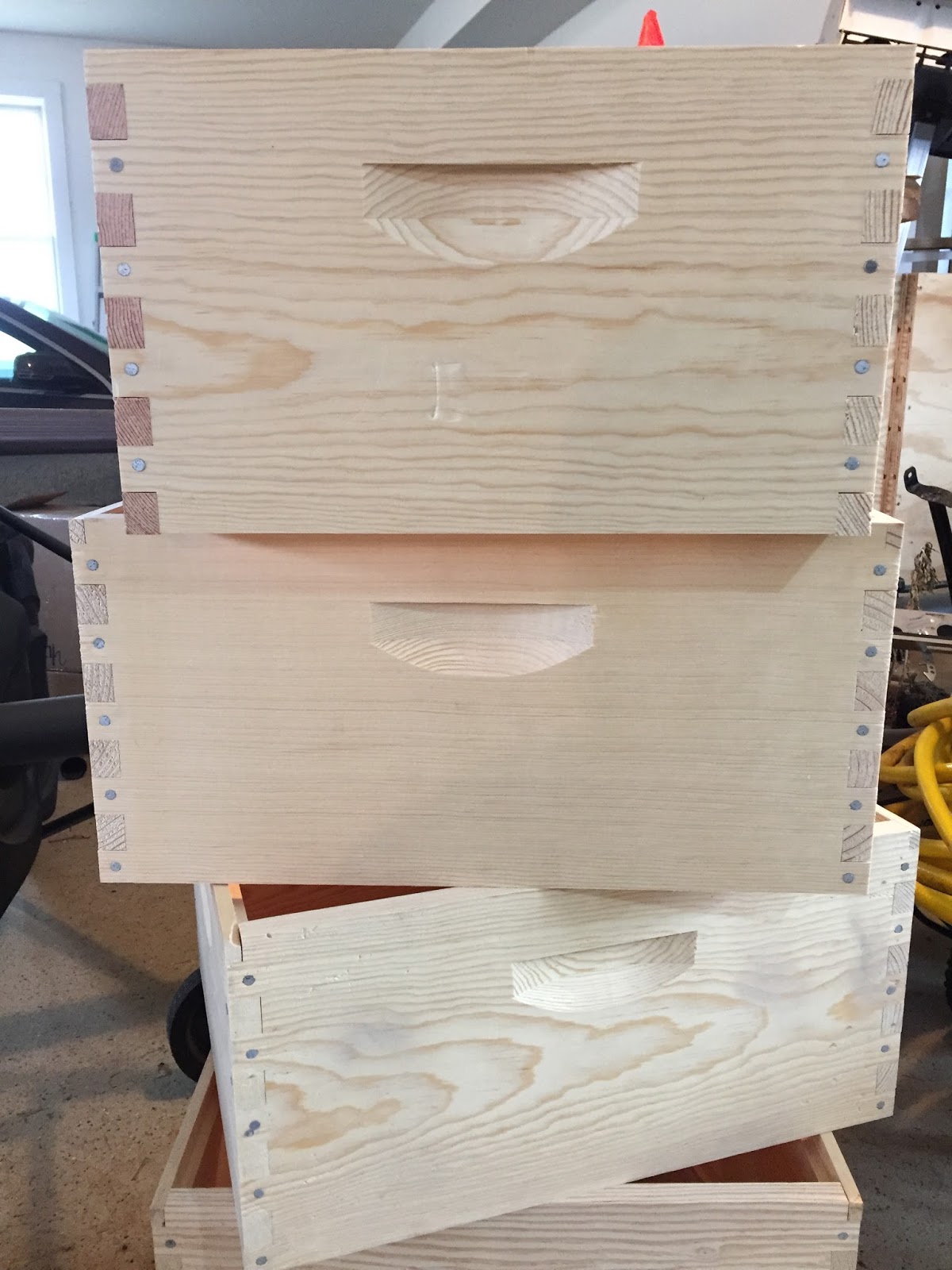
Here is one primed and with the hole in place.


I also ordered new outer covers, inner covers, and screened bottom boards. I decided to try black foundation for the frames this time. It is supposed to make it easier to see the eggs and small larvae. Below is a picture of an empty, assembled frame. Below that is a picture of the foundation that will go into those frames. Below that further are the assembled and painted pieces on our lawn, airing out.


Sunday, April 10, 2016
Hiving Two Packages of Bees on April 10, 2016
I have photos and videos yet to be posted. Hiving the Carniolan Honeybees and the Italian Honeybees went well. They each seem to be taking to their new home.
Tuesday, April 5, 2016
Preparing for the 2016 beekeeping season.
It's been a while since I posted here. Last year, I put out the top-bar hive (Hive Beta) and installed bees into it. I also cleaned and put new bees into my two Langstroth hives (Hive A and Hive B). They all seemed to do well, but I ended up combining medium hive bodies from Hive B to Hive A so that Hive A would survive the winter. Hive Beta seemed to be behind, and I think it was due to me not much feeding syrup to them and the bees truly starting from scratch--an empty hive with no foundation or wax at all.
We put a thermometer into Hive A, and we could see that the bees were alive as recently as late-January of 2016. In fact, on one day, the hive was in the high-90's when the ambient temperature in the area was well below freezing.
I have yet to check Hive A or Hive Beta. I don't think that either survived, but I haven't had a chance to crack either of them open. I did put straw bales around them this year, and that is a first for me.
Going forward, I'm going to move to deep hive bodies. I only need to use three of them instead of the five mediums that I have been using. They will be heavier, but easier to and track.
I just got word that the bees are coming Sunday, April 10, 2016. I tried a guy who is closer than the place I was using in Stillwater, so we'll see how pick-up goes.
I need to get the hive bodies ready. They are assembled, but I have to drill the holes, get the corks, prime them, and paint them. I also have to assemble at least 20 frames for the deeps.
We put a thermometer into Hive A, and we could see that the bees were alive as recently as late-January of 2016. In fact, on one day, the hive was in the high-90's when the ambient temperature in the area was well below freezing.
I have yet to check Hive A or Hive Beta. I don't think that either survived, but I haven't had a chance to crack either of them open. I did put straw bales around them this year, and that is a first for me.
Going forward, I'm going to move to deep hive bodies. I only need to use three of them instead of the five mediums that I have been using. They will be heavier, but easier to and track.
I just got word that the bees are coming Sunday, April 10, 2016. I tried a guy who is closer than the place I was using in Stillwater, so we'll see how pick-up goes.
I need to get the hive bodies ready. They are assembled, but I have to drill the holes, get the corks, prime them, and paint them. I also have to assemble at least 20 frames for the deeps.
Sunday, April 5, 2015
Controlled burn this spring?
The prescribed burn that I discussed in my September of 2014 entry was postponed to this spring. Prairie Restorations, Inc. believes that they will conduct the burn this month yet. Ideally, it would be done before the bees arrive, but I believe we can burn around the hives and the bees shouldn't be overly bothered.
Saturday, April 4, 2015
New bee arrival date; hives ready.
The bees now arrive on April 18, 2015. The distribution center is Nature's Nectar in Stillwater. Pick-up day is very busy, and Nature's Nectar used to have certain times that you could arrive--depending on your last name. If you are far enough away (as I am), I think you can show up whenever you are able.
The hives are ready to go. I had to (or decided to) throw away many frames after my bees died during the winter of '13 - '14. I believe that they just died from a cold snap and not from any diseases. There was some rotting of the bees and many of the frames were, I though, no longer useful.
So, I'll need to order about 100+ frames, I think. Both A1 and B1 need new frames. Also, as I might show you in an upcoming post, I think that Beta is going to also use those frames.
I have some pollen patties from the first season that I had the bees, 2013. They've been in the refrigerator since then. They may still be good, but I don't know how to determine that, frankly...
I'm also struggling with how I'll feed syrup to the bees in Beta. I may have to use an external feeder and just hope that A1 and B1 leave that syrup alone once they find their own syrup in their hives.
 |
| The hives for spring 2015: Langstroth (Hive A), a Kenyan top-bar hive (Beta), and another Langstroth (Hive B) |
The hives are ready to go. I had to (or decided to) throw away many frames after my bees died during the winter of '13 - '14. I believe that they just died from a cold snap and not from any diseases. There was some rotting of the bees and many of the frames were, I though, no longer useful.
So, I'll need to order about 100+ frames, I think. Both A1 and B1 need new frames. Also, as I might show you in an upcoming post, I think that Beta is going to also use those frames.
I have some pollen patties from the first season that I had the bees, 2013. They've been in the refrigerator since then. They may still be good, but I don't know how to determine that, frankly...
I'm also struggling with how I'll feed syrup to the bees in Beta. I may have to use an external feeder and just hope that A1 and B1 leave that syrup alone once they find their own syrup in their hives.
Tuesday, March 10, 2015
New bees on their way.
A brief update… My bees died last winter, and I didn't find out soon enough to order new ones. We harvested some honey from the hives.
So, this spring, I will be starting my second year of beekeeping. I'm going to restart my two Langstroth hives, and add to my apiary by installing bees into a top bar hive that to my dad and I made several summers ago.
Bees arrive 4/25/2015.
Saturday, September 6, 2014
Controlled burn planned for fall of 2014.
Our two hives are at the edge of our ~40 acres of restored prairie. This fall, we plan to do a controlled burn of the prairie. To minimize property damage, fatalities, and other catastrophe, the fine folks at Prairie Restorations, Inc. will be helping us.
The image below is not mine, and comes from here.
 |
| A prescribed or controlled burn of a prairie. |
Bees died over the winter of 2013 - 2014.
The 2013 - 2014 winter in Minnesota was a tough one for bees and certainly for my two hives; they both died. In late December, we think that we saw evidence of cleansing flights, and I saw live bees in the hive when I looked through the top open hole.
But, come spring, both hives were dead. When we opened each hive, we could see bees next to capped honey. They died "head down" in the cell as if they were trying to get the last bit of honey out of the cell. The mite counts were low going into the winter, and I saw no evidence of disease of infestation. So, it may be that the cold was just too much for the cluster of bees to move to new areas of honey.
In the spring/summer, we harvested the honey. There wasn't a great deal of it, so we used the crush and strain method with a household stainless steel mesh strainer. The harvest is below.
We also used a double-boiler to melt and purify the wax. We now have about 2 pounds of pure beeswax. (No picture currently available.) There are still fine bits of wax in the honey. We eat it this way. But, before we give it to others, we have been using 4 layers of cheesecloth as a final straining.
But, come spring, both hives were dead. When we opened each hive, we could see bees next to capped honey. They died "head down" in the cell as if they were trying to get the last bit of honey out of the cell. The mite counts were low going into the winter, and I saw no evidence of disease of infestation. So, it may be that the cold was just too much for the cluster of bees to move to new areas of honey.
In the spring/summer, we harvested the honey. There wasn't a great deal of it, so we used the crush and strain method with a household stainless steel mesh strainer. The harvest is below.
 |
| Honey from hives A and B (mixed) before final straining. |
We also used a double-boiler to melt and purify the wax. We now have about 2 pounds of pure beeswax. (No picture currently available.) There are still fine bits of wax in the honey. We eat it this way. But, before we give it to others, we have been using 4 layers of cheesecloth as a final straining.
Sunday, September 1, 2013
Varroa mite counting, round 4.
On 8/3/2013 at 1310, I removed the sticky board from beneath each hive. The boards had been in for about 2.5 days. Unfortunately, I lost track of specifically when I placed the boards.
Hive A had 17 - 19 mites on the board. When I removed the boards, I scraped off some Vaseline and (likely) mites. So, I estimated the number of mites that might have been in the ninth of the board to be 3 instead of the 1 that I counted. Hence, I'm going to go with the higher number.
Hive B had 33 mites on the board. One reference that I recall said that greater than 40 mite (in one day, mind you) was another indication for treatment. I'm still below that number, at least. In any event, I continue with the mites per 1,000 bees per day calculations below.
On 6/16/2013, Hive A had a population of about 9,375 bees (7.5 frames full of bees x 1,250 bees per full frame). On the same date, Hive B had a population of about 12,500 bees (10 frames full of bees x 1,250 bees per full frame). Again, we are going to say that this is over 4 days of collection.
Even if the boards were only in for one day--and thus the mite numbers would be 0.12 and 0.8 mites per thousand bees per day--there would not be a clear indication to treat.
After this mite count, I did not get to a mite count for over a month. I did an about 2.5-day mite count that ended on 8/3/2013. There were significantly more mites, but there were also significantly more bees. I'm hoping to do an inspection over the weekend of 8/3/2013 so that I can get a good estimate of numbers of bees.
Hive A had 17 - 19 mites on the board. When I removed the boards, I scraped off some Vaseline and (likely) mites. So, I estimated the number of mites that might have been in the ninth of the board to be 3 instead of the 1 that I counted. Hence, I'm going to go with the higher number.
Hive B had 33 mites on the board. One reference that I recall said that greater than 40 mite (in one day, mind you) was another indication for treatment. I'm still below that number, at least. In any event, I continue with the mites per 1,000 bees per day calculations below.
On 6/16/2013, Hive A had a population of about 9,375 bees (7.5 frames full of bees x 1,250 bees per full frame). On the same date, Hive B had a population of about 12,500 bees (10 frames full of bees x 1,250 bees per full frame). Again, we are going to say that this is over 4 days of collection.
- Hive A: 1 mite per 9,375 bees per 4 days = 1/(9,375 x 4) = 0.03 mites per 1,000 bees per day.
- Hive B: 10 mites per 12.5k bees per 4 days = (1/12,500 x 4) = 0.2 mites per 1,000 bees per day.
Even if the boards were only in for one day--and thus the mite numbers would be 0.12 and 0.8 mites per thousand bees per day--there would not be a clear indication to treat.
After this mite count, I did not get to a mite count for over a month. I did an about 2.5-day mite count that ended on 8/3/2013. There were significantly more mites, but there were also significantly more bees. I'm hoping to do an inspection over the weekend of 8/3/2013 so that I can get a good estimate of numbers of bees.
Saturday, August 3, 2013
Varroa mite counting, round 3.
On 6/20/2013 (this makes this post somewhat out of order), I removed the sticky board from beneath each hive. The boards had been in for about 4 days. Unfortunately, I lost track of when I placed the boards, but I did note that I removed them on 6/20/2013 at 1750.
Hive A had only 1 mite on the board. Hive B had 10 mites on the board. On 6/16/2013, Hive A had a population of about 9,375 bees (7.5 frames full of bees x 1,250 bees per full frame). On the same date, Hive B had a population of about 12,500 bees (10 frames full of bees x 1,250 bees per full frame). Again, we are going to say that this is over 4 days of collection.
So, from the numbers above, I feel that I am comfortable not treating for mites at this time. The quote that I am following, you might recall, is the following: "If your sticky board count shows more than 2 mites per thousand bees per day in mid-August or more than 4 mites per thousand bees per day in September, you should find a way to reduce the mite population."
Even if the boards were only in for one day--and thus the mite numbers would be 0.12 and 0.8 mites per thousand bees per day--there would not be a clear indication to treat.
After this mite count, I did not get to a mite count for over a month. I did an about 2.5-day mite count that ended on 8/3/2013. There were significantly more mites, but there were also significantly more bees. I'm hoping to do an inspection over the weekend of 8/3/2013 so that I can get a good estimate of numbers of bees.
Hive A had only 1 mite on the board. Hive B had 10 mites on the board. On 6/16/2013, Hive A had a population of about 9,375 bees (7.5 frames full of bees x 1,250 bees per full frame). On the same date, Hive B had a population of about 12,500 bees (10 frames full of bees x 1,250 bees per full frame). Again, we are going to say that this is over 4 days of collection.
- Hive A: 1 mite per 9,375 bees per 4 days = 1/(9,375 x 4) = 0.03 mites per 1,000 bees per day.
- Hive B: 10 mites per 12.5k bees per 4 days = (1/12,500 x 4) = 0.2 mites per 1,000 bees per day.
So, from the numbers above, I feel that I am comfortable not treating for mites at this time. The quote that I am following, you might recall, is the following: "If your sticky board count shows more than 2 mites per thousand bees per day in mid-August or more than 4 mites per thousand bees per day in September, you should find a way to reduce the mite population."
Even if the boards were only in for one day--and thus the mite numbers would be 0.12 and 0.8 mites per thousand bees per day--there would not be a clear indication to treat.
After this mite count, I did not get to a mite count for over a month. I did an about 2.5-day mite count that ended on 8/3/2013. There were significantly more mites, but there were also significantly more bees. I'm hoping to do an inspection over the weekend of 8/3/2013 so that I can get a good estimate of numbers of bees.
Thursday, August 1, 2013
Adding a box and brief inspection, on July 7, 2013.
Fifth inspection of Hive A and Hive B, Sunday, 7/7/13:
This was day 64 for the two hives, with the packages having been installed Saturday the 4th of May, 2013. The main goals for this inspection were:
Anyway, we could have done a full inspection today, but it was pretty darn hot... Three factors weighed heavily on my mind and kept me moving quickly:
For this inspection, I was worried that I had let too much time pass between inspections. I was most concerned that I would find that the bees had filled all available space and I was wasting their time and resources by not providing them enough space. The boxes were quite full, but not completely full; the bees still had room to expand. But, I would not have wanted to wait much longer to add the 3rd box.
- Enlarge each hive's entrance by moving the entrance reducer to the larger of its two settings; and,
- Add a third box to each hive.
 |
| The hives before inspection and adding third box. |
In the picture above, you see that there are three boxes. Recall that A3 and B3 are empty of frames and only hold the syrup pail. Only A1/A2 and B1/B2 are full of frames, bees, and comb.
Regarding the entrance reducer... If I was using deep hive bodies, I would open up the entrance more when I added the 2nd of 3 total boxes. So, I figured that I would do that step when I added my 3rd of 5 total boxes. I think that I could have removed the entrance reducer completely. This may have helped the bees keep their hive cooler. However, since the would also have uncorked holes in the 1st and the 2nd boxes of each hive, I opted to leave the entrance reducer in place but to the more open setting.
- The bees were hot and jumpy. I wanted to bother them as little as possible.
- The heat was oppressive. The beekeeping suits only worsened our sweaty plight.
- My videographer was being attacked by mosquitos. She was throwing off palpable waves of anger that assaulted me much more forcefully than the heat was...
For this inspection, I was worried that I had let too much time pass between inspections. I was most concerned that I would find that the bees had filled all available space and I was wasting their time and resources by not providing them enough space. The boxes were quite full, but not completely full; the bees still had room to expand. But, I would not have wanted to wait much longer to add the 3rd box.
Flowers and bees on flowers.
Our prairie and homesite has many flowers for the bees...
 |
| Common Milkweed in bloom |
 |
| Large patch of Blackeyed Susans |
 |
| Honeybee on Blackeyed Susan |
 |
| Honeybee on Blackeyed Susan, closer |
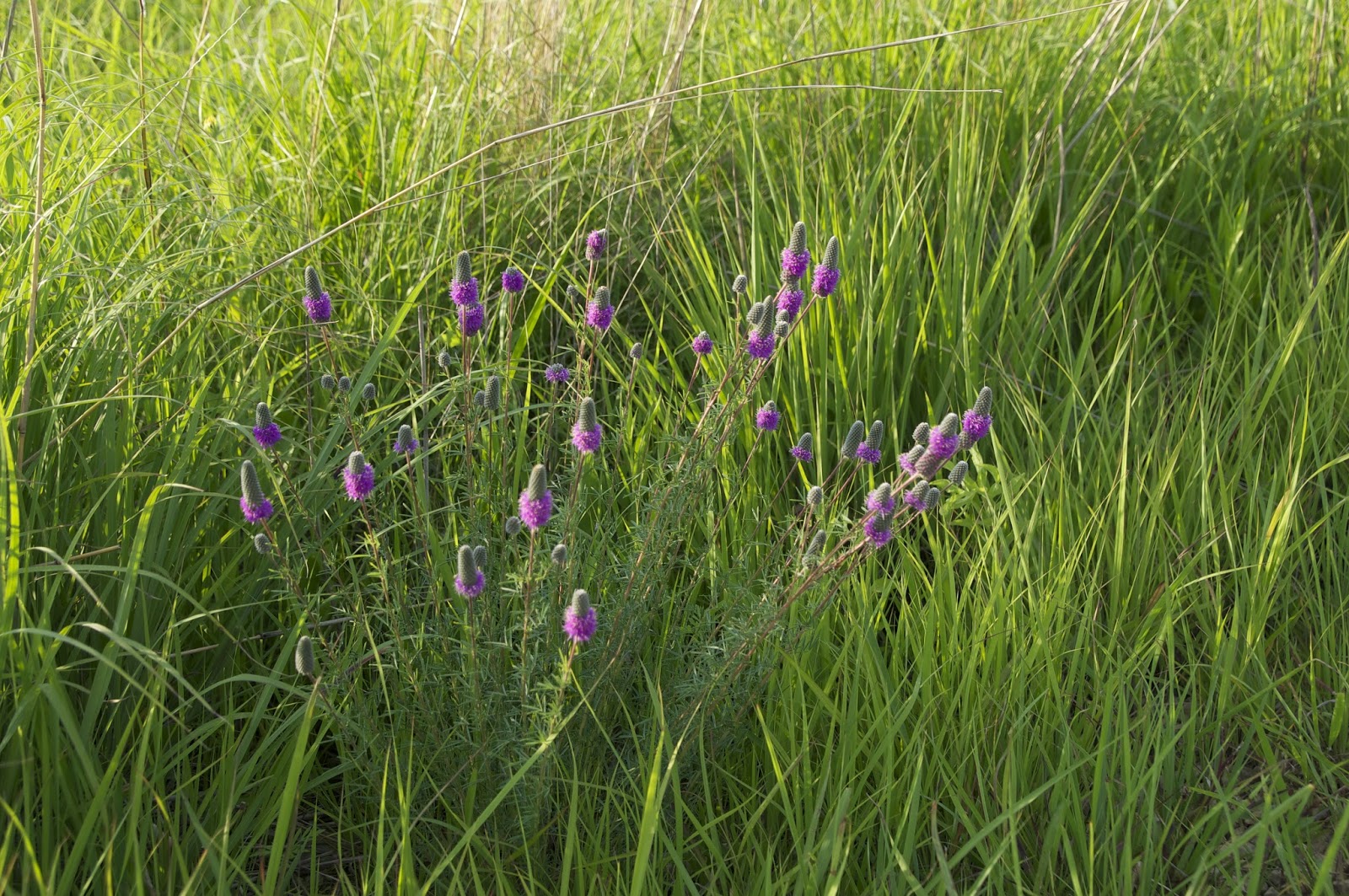 |
| Purple Prairie Clover |
 |
| Purple Prairie Clover, closer |
 |
| Prairie False Indigo in bloom |
 |
| Prairie False Indigo in fruit |
 |
| Closer view of Prairie False Indigo fruit |
 |
| Blue Vervain or Hoary Vervain, not sure which... |
First inspection with two boxes on each hive, part 2.
Fourth inspection of Hive A and Hive B, Sunday, 6/16/13:
[Note: This is follow-up to the July 7, 2013 post, with video links below.]
To recap, this was day 43 for the hives, with the packages having been installed Saturday the 4th of May, 2013. We were able to do a full inspection today, as the weather was in the mid-70's. The inspection started at about 1820. There were two boxes on each hive, and I felt a bit more rushed for time. But, overall it went well. Inspection ended at 1850.
The videos (part 1 and part 2) tell most of the tale. It was fun to see the bees moving into their second box and drawing out more comb. With how much wax they were making (and how little syrup they were taking in), they were clearly finding a great deal of nectar in the wild.
To recap, this was day 43 for the hives, with the packages having been installed Saturday the 4th of May, 2013. We were able to do a full inspection today, as the weather was in the mid-70's. The inspection started at about 1820. There were two boxes on each hive, and I felt a bit more rushed for time. But, overall it went well. Inspection ended at 1850.
The videos (part 1 and part 2) tell most of the tale. It was fun to see the bees moving into their second box and drawing out more comb. With how much wax they were making (and how little syrup they were taking in), they were clearly finding a great deal of nectar in the wild.
Wednesday, July 3, 2013
First inspection with two boxes on each hive.
Fourth inspection of Hive A and Hive B, Sunday, 6/16/13:
This was day 43 for the hives, with the packages having been installed Saturday the 4th. I was able to do a full inspection today, as the weather was in the mid-70's. The inspection started at about 1820. There were two boxes on each hive, and I felt a bit more rushed for time. But, overall it went well.
Again, the bees took very little syrup. They had taken less than 10% of the gallon that they each had available. Interestingly, the lid of the feeder pail is covered with bees; yet, they take so little syrup. So, I only provided 1/2 gallon to each hive, new buckets. I also added pollen patties to each hive, but just 1/2 a patty per hive. I'm not sure what the shelf life of a pollen patty is, and I have a dozen, so I thought I'd see if they could make use of it.
For the inspection of Hive A, I tried to take of box A-2 but found it to be very heavy. I soon learned that I was pulling up 4 central frames from A-1 that were burr comb attached to the frames above them. When they broke apart, honey and nectar started pouring from the broken comb. This was unfortunate, but unavoidable. If the burr comb (comb that is built out of place) isn't dealt with regularly, the condition will only worsen. Subsequent inspections can become even more damaging to the bees or even more difficult to carry out.
This is an incomplete post without a video (yet). I'm hoping to edit the video over the 4th of July holiday and get it posted. I have another inspection to be done this week/weekend, too.
Again, the bees took very little syrup. They had taken less than 10% of the gallon that they each had available. Interestingly, the lid of the feeder pail is covered with bees; yet, they take so little syrup. So, I only provided 1/2 gallon to each hive, new buckets. I also added pollen patties to each hive, but just 1/2 a patty per hive. I'm not sure what the shelf life of a pollen patty is, and I have a dozen, so I thought I'd see if they could make use of it.
For the inspection of Hive A, I tried to take of box A-2 but found it to be very heavy. I soon learned that I was pulling up 4 central frames from A-1 that were burr comb attached to the frames above them. When they broke apart, honey and nectar started pouring from the broken comb. This was unfortunate, but unavoidable. If the burr comb (comb that is built out of place) isn't dealt with regularly, the condition will only worsen. Subsequent inspections can become even more damaging to the bees or even more difficult to carry out.
This is an incomplete post without a video (yet). I'm hoping to edit the video over the 4th of July holiday and get it posted. I have another inspection to be done this week/weekend, too.
Monday, June 10, 2013
Hives busy this afternoon... Swarming? Hot?
First, I'll load in a panorama shot of the hives in their prairie with the backdrop of the forest. If you click on the image, it should load up a larger view. It is wide enough that you may have to scroll it sideways or otherwise manipulate the image, depending on your computer or device.
Here is a YouTube video of the mite count (first half of the clip) and my attempt to re-set the entrance reducer without getting stung (second half).
As we approached the hives this afternoon for a visual-only inspection, we saw a visitor....
I don't think that the squirrel family of animals eats hives or honey, so I'm going to assume the little fella had no evil intentions.
Back to the hives, we saw that the hives were busier than we are used to seeing. More bees were on the outside of the hive, and many were flying in front of the hives. It has been quite warm and humid, so my hope is that this activity is normal and not indicative of a problem, and absconding, or a swarm.
One thought is that the colony is old enough that some of the newer bees may be starting to forage. If this is the case, they may be making orientation flights; after all, this might be the first time that they've been out of the hive. The movement in front of the hive seemed to look like orientation flights to me, but I'm certainly no expert.
I could also see that Hive B's entrance reducer had somehow been knocked out of place and deeper into the hive.
I'm interested in why the entrance reducer was out of place. I have read that the bees's activity can move the entrance reducer. However, this is usually in the form of pushing the entrance reducer further out. It seems to me that this was pushed in. Perhaps a skunk? A mouse? I may need to set up my trail camera in this area to see what is happening during the night and while we aren't at the hives.
I wanted to look inside the hives, but this may need to wait until later in the week. I am hoping that I won't find an intruder in Hive B.
 |
| Click to enlarge this panorama view of the hives (roughly center of pic). |
Here is a YouTube video of the mite count (first half of the clip) and my attempt to re-set the entrance reducer without getting stung (second half).
As we approached the hives this afternoon for a visual-only inspection, we saw a visitor....
 |
| Ground squirrel. |
I don't think that the squirrel family of animals eats hives or honey, so I'm going to assume the little fella had no evil intentions.
Back to the hives, we saw that the hives were busier than we are used to seeing. More bees were on the outside of the hive, and many were flying in front of the hives. It has been quite warm and humid, so my hope is that this activity is normal and not indicative of a problem, and absconding, or a swarm.
One thought is that the colony is old enough that some of the newer bees may be starting to forage. If this is the case, they may be making orientation flights; after all, this might be the first time that they've been out of the hive. The movement in front of the hive seemed to look like orientation flights to me, but I'm certainly no expert.
I could also see that Hive B's entrance reducer had somehow been knocked out of place and deeper into the hive.
 |
| Entrance reducer has been knocked out of place. |
I'm interested in why the entrance reducer was out of place. I have read that the bees's activity can move the entrance reducer. However, this is usually in the form of pushing the entrance reducer further out. It seems to me that this was pushed in. Perhaps a skunk? A mouse? I may need to set up my trail camera in this area to see what is happening during the night and while we aren't at the hives.
I wanted to look inside the hives, but this may need to wait until later in the week. I am hoping that I won't find an intruder in Hive B.
Varroa mite counting, round 2.
On June 4, 2013, I placed freshly-Vaselined sticky boards back under the screened bottoms. Please see this link for a refresher on screened bottom boards. This link will take you to the June 2nd post on Varroa mite counting.
Today, June 10, 2013, I removed the sticky boards to do my 2nd varroa mite count. Hive A had only one mite, and Hive B had five. If I use the bee population estimates from my 6/2/13 post:
* = Sticky boards were placed at 0630 on 6/4 and removed at 1445 on 6/10.
On these two pictures of the sticky boards, you can see the normal droppings of a hive. The lines on the board of yellowish material represents pollen, wax bits, and other particles that drop from bees and comb during day-to-day functioning. The refuse falls in lines, for that is where the bee space is between the frames of drawn comb.
Next in the plan for mite counting is to do another sticky board count but try do a simultaneous powdered sugar roll count. I'll describe that in a future post.
Today, June 10, 2013, I removed the sticky boards to do my 2nd varroa mite count. Hive A had only one mite, and Hive B had five. If I use the bee population estimates from my 6/2/13 post:
- Hive A: Across 6.3 days,* 1 mite per 6,250 bees = 0.03 mites per 1,000 bees per day.
- Hive B: Across 6.3 days, 5 mites per 6,875 bees = 0.12 mites per 1,000 bees per day.
I would note that Hive B does seem to have a higher mite load than Hive A. So, perhaps the numbers seen in the June 2nd post are correct, despite my fears that the sticky board method I used might have led to error.
In any event, the mite load of each hive appears to be very low. So, I will continue to monitor the mites. I won't do any treatment yet.
 |
| Hive A's sticky board. |
On these two pictures of the sticky boards, you can see the normal droppings of a hive. The lines on the board of yellowish material represents pollen, wax bits, and other particles that drop from bees and comb during day-to-day functioning. The refuse falls in lines, for that is where the bee space is between the frames of drawn comb.
 |
| Hive B's sticky board. |
 |
| Somewhere, a bee is walking in left-ward or right-ward circles, depending upon which leg this is... |
Next in the plan for mite counting is to do another sticky board count but try do a simultaneous powdered sugar roll count. I'll describe that in a future post.
Friday, June 7, 2013
Trailer(s) for "More Than Honey" recently released.
A movie entitled More Than Honey is set to be released on June 12, 2013. The synopsis for this movie follows:
"Oscar-nominated director Markus Imhoof (THE BOAT IS FULL) tackles the vexing issue of why bees, worldwide, are facing extinction. With the tenacity of a man out to solve a world-class mystery, he investigates this global phenomenon from California to Switzerland, China and Australia. Exquisite macro-photography of the bees (reminiscent of MICROCOSMOS), in flight and in their hives, reveals a fascinating and complex world in crisis."
Click this link to see the official site. This link points to the trailer. I'm not sure how permanent each link will be.
"Oscar-nominated director Markus Imhoof (THE BOAT IS FULL) tackles the vexing issue of why bees, worldwide, are facing extinction. With the tenacity of a man out to solve a world-class mystery, he investigates this global phenomenon from California to Switzerland, China and Australia. Exquisite macro-photography of the bees (reminiscent of MICROCOSMOS), in flight and in their hives, reveals a fascinating and complex world in crisis."
Click this link to see the official site. This link points to the trailer. I'm not sure how permanent each link will be.
As far as I know, there are two trailers. One I can access on my iPhone's "Trailers" app. The other is linked to above. The trailers show off a lot of in-hive footage. There are bees in flight, emerging from cells, communicating, etc. There is footage of bees in flight. One of the trailers even--somehow--had footage of a drone mating with a queen. There is footage of a Varroa mite on a bee.
Wednesday, June 5, 2013
Kenyan top-bar hive.
A few summers ago, my dad and I made a Kenyan top-bar hive.
It is meant to emulate a hollowed-out log hive with bars across the top, presumably used in Kenya and the surrounding areas.
I entered into the Nicollet County Fair last summer and received a blue ribbon and a $2 - $3 prize. I was so drenched in fame and fortune that I could no longer appear in public. However, that's a story for another post...
The following two pictures show the hive with the top cover (the blue-colored cover) off. You can see four of the bars standing upright. This shows you the underside of the bars. A thin wood strip is embedded into the bottom of the bars. The goal is that these will prompt the bees to build comb on each bar's underside there and there only.
You can also see into the hive itself. The large, empty cavity will be eventually filled with parallel strips of comb growing down from the bars arranged across the top.


Below was my attempt to put the camera into the hive and take a picture of the underside of the bars. This is what the bees would "see" from within the hive. They would ideally see the rows of low points and build comb down from each wooden strip.
In case the pictures are difficult to interpret, the main part of the hive is like a large, trapezoidal, feeding or watering trough. This shape keeps the bees from attaching comb to the sides of the hive. The bars are placed across the top. They fit together with no gap between the bars. On the underside of the bars, a thin strip of wood was glued in. Think of a popsicle stick, but larger and a bit thicker. The idea with this "starter strip" is that the bees will use these to guide their comb production. Hence, the comb will be nicely parallel and allow me to inspect the hive without destroying "cross comb" pieces.
I haven't yet put bees into it, as I heard that bees cannot over-winter in MN in a top-bar hive. However, another blog that I follow (http://topbarbeesmn.blogspot.com) and blogs mentioned by the author give me hope that I might be able to get bees to survive the winter in the Kenyan top-bar hive.
My plan now is to place it out in the prairie next spring. If my two current hives survive the winter, they may be likely to swarm next spring/summer. If I can either catch a swarm to install it into the Kenyan top-bar hive or bait a swarm into it, I can get going with that hive.
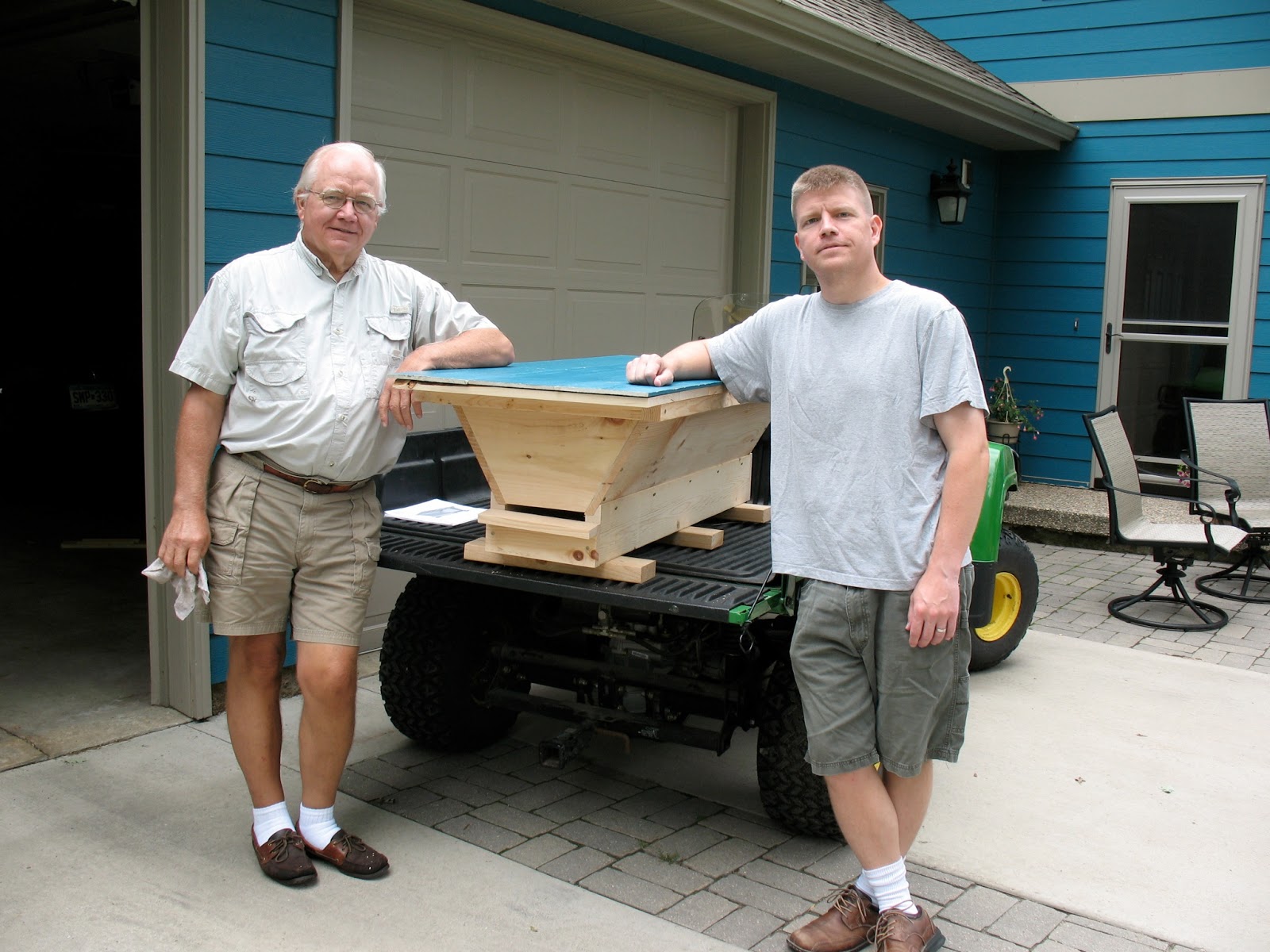 |
| Kenyan top-bar hive carpenters and their finished product. |
It is meant to emulate a hollowed-out log hive with bars across the top, presumably used in Kenya and the surrounding areas.
 |
| Front-ish view. |
 |
| Side view. |
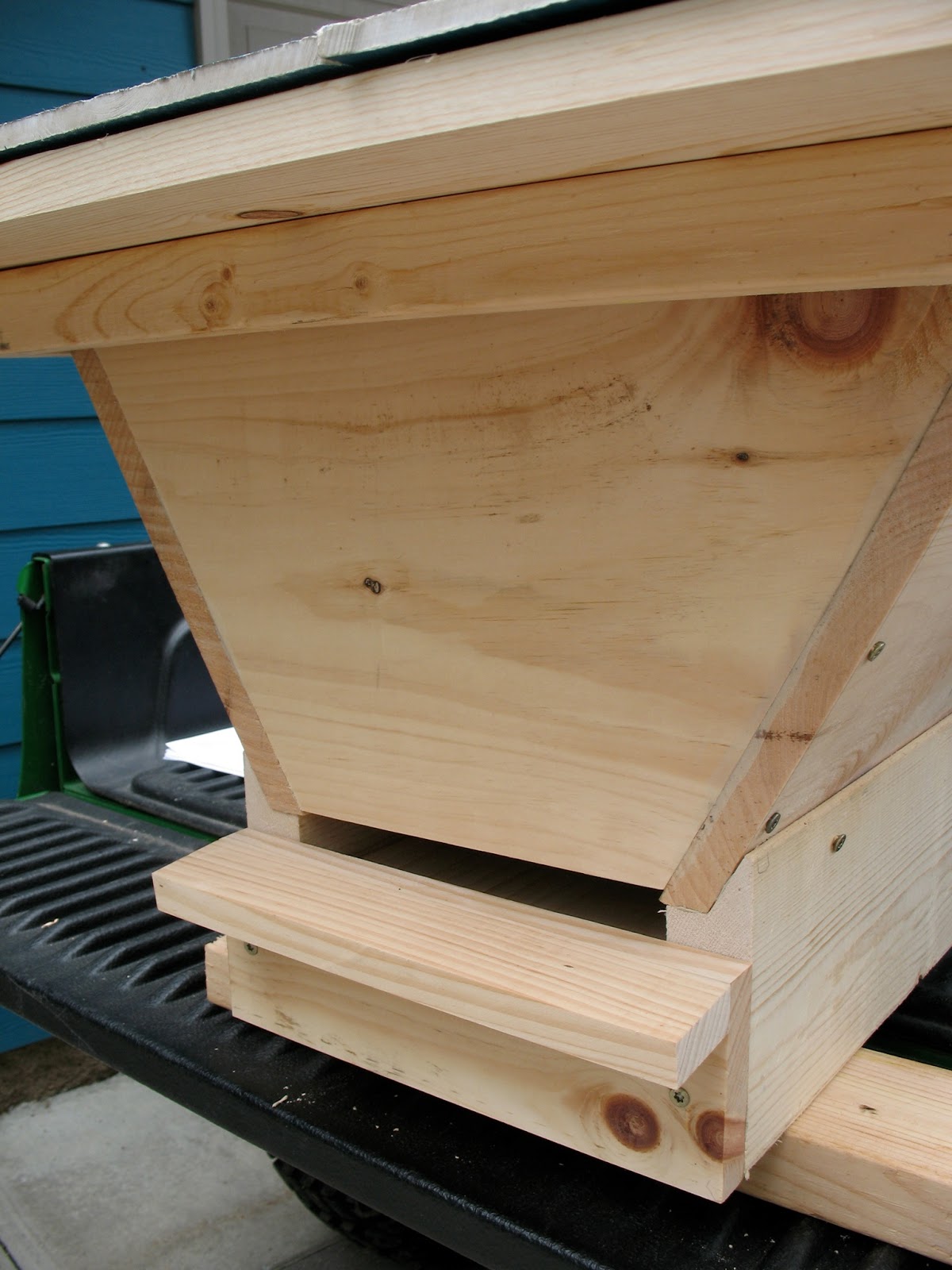 |
| A closer view of the entrance and the landing board. |
I entered into the Nicollet County Fair last summer and received a blue ribbon and a $2 - $3 prize. I was so drenched in fame and fortune that I could no longer appear in public. However, that's a story for another post...
 |
| A view of the underside of the top cover. |
 |
| The cover is off, and you can see the top surface of the cover. That the cover surface is suspiciously like the house's siding is purely coincidental, of course. |
The following two pictures show the hive with the top cover (the blue-colored cover) off. You can see four of the bars standing upright. This shows you the underside of the bars. A thin wood strip is embedded into the bottom of the bars. The goal is that these will prompt the bees to build comb on each bar's underside there and there only.
You can also see into the hive itself. The large, empty cavity will be eventually filled with parallel strips of comb growing down from the bars arranged across the top.


Below was my attempt to put the camera into the hive and take a picture of the underside of the bars. This is what the bees would "see" from within the hive. They would ideally see the rows of low points and build comb down from each wooden strip.
 |
| A view from inside the hive, looking up at the top bars. |
In case the pictures are difficult to interpret, the main part of the hive is like a large, trapezoidal, feeding or watering trough. This shape keeps the bees from attaching comb to the sides of the hive. The bars are placed across the top. They fit together with no gap between the bars. On the underside of the bars, a thin strip of wood was glued in. Think of a popsicle stick, but larger and a bit thicker. The idea with this "starter strip" is that the bees will use these to guide their comb production. Hence, the comb will be nicely parallel and allow me to inspect the hive without destroying "cross comb" pieces.
I haven't yet put bees into it, as I heard that bees cannot over-winter in MN in a top-bar hive. However, another blog that I follow (http://topbarbeesmn.blogspot.com) and blogs mentioned by the author give me hope that I might be able to get bees to survive the winter in the Kenyan top-bar hive.
My plan now is to place it out in the prairie next spring. If my two current hives survive the winter, they may be likely to swarm next spring/summer. If I can either catch a swarm to install it into the Kenyan top-bar hive or bait a swarm into it, I can get going with that hive.
Subscribe to:
Posts (Atom)